

Why You Should Think Twice About Installing Tile on a Second Floor
Tile feels like the safe choice.
It is durable, it lasts, and it always looks clean. So people start using it everywhere, including upstairs, thinking they are making a long term upgrade.
That is where things start to go wrong.
Tile and a wood framed second floor do not behave the same way, even if everything feels solid when you walk on it.
Tile Needs Something That Does Not Move
Tile is rigid. It does not flex, it does not absorb movement, and it does not adjust over time. It needs a surface that stays stable.
Concrete gives you that. A wood framed floor does not.
Even when a second floor feels strong, there is always some level of movement in the structure. It is subtle, but it is there, and that is enough.
The Problem Is Not Today
It Is What Happens Over Time
A wood framed second floor is designed to have a little bit of give. That is normal.
People walking through the space, furniture shifting, everyday use. All of that creates movement.
You do not notice it, but the tile does.
That is why everything can look great at first. Then slowly, things start to change.
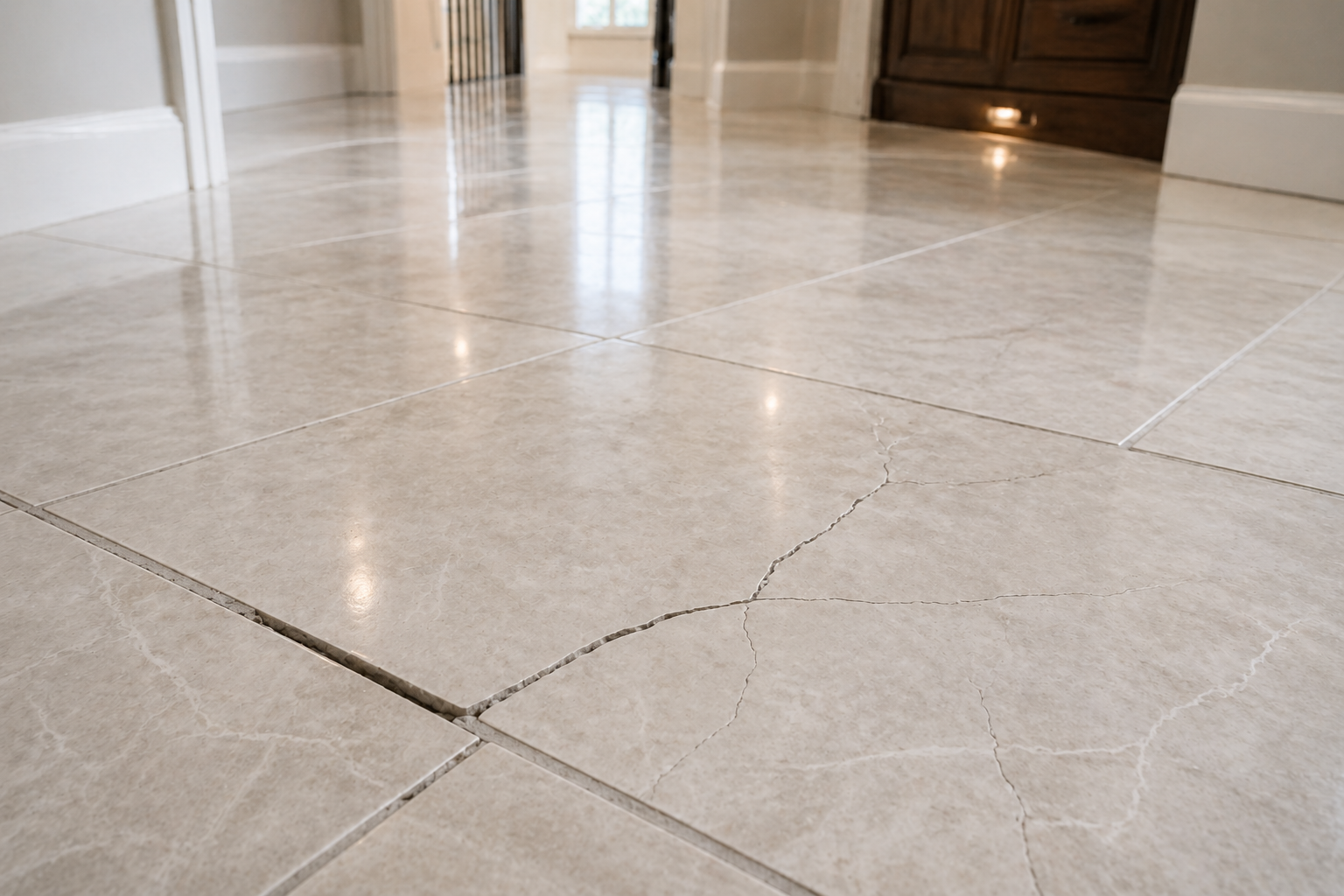
You might see a small crack in the grout. A tile that sounds slightly hollow. A joint that starts to separate just a little.
Over time, that turns into cracked tiles or sections that start to loosen.
And at that point, it is not a small fix.
Cement Board Does Not Change the Structure
This is where people get talked into it.
You will hear that cement board will make it solid. That it creates the right base for tile and prevents issues.
It does not change the structure underneath it.
Cement board does not eliminate movement in the floor. It does not stop deflection between joists. It does not turn a wood framed system into something rigid.
It is part of a proper install, but it is not a guarantee of performance.
The movement is still there, and tile does not forgive that.
No One Can Guarantee This Will Hold Up
You will hear that it can be done without issues. That the right installation method will make it hold up over time.
The reality is, no one can guarantee that.
There are too many variables in a second floor system. Framing, spacing, subfloor condition, long term movement. All of it plays a role.
Even with a good installation, those factors do not go away.
And when tile is involved, that matters.
Stairs Are an Even Bigger Problem
Tile should not be installed on stairs leading to an upper floor.
Stairs take constant impact. Every step carries force through the structure, and that repeated stress works against a rigid material like tile.
Over time, it leads to cracking and loosening.
There is also the safety side of it. Tile can be slick, especially on stair treads, and that is not where you want to take that risk.
It Also Changes How Your House Feels
Tile upstairs does not just affect performance, it affects how your home lives.
Sound travels more. Every step is sharper. Rooms below feel it.
What seemed like a clean, durable choice starts to feel loud and a little harsh over time.
Fixing It Is Not Simple
Once tile is installed upstairs and starts to fail, there is no easy fix.
It usually means tearing it out, repairing the subfloor, and starting over with a different material.
It is disruptive, and it is expensive.
What Works Better
Second floors need materials that can move with the structure instead of fighting it.
Engineered wood, luxury vinyl, even carpet in the right areas.
Materials that can handle a little bit of movement without turning it into a problem.
The Bottom Line
Tile needs a surface that stays stable.
A wood framed second floor is not that, and nothing added on top of it changes that reality.
Cement board does not fix it. Installation methods do not remove the risk. And no one can guarantee how it will perform over time.
It might look great in the beginning.
But if it starts to fail, it is not a small issue.
Disclaimer
This article is provided for general educational purposes only and is intended to help homeowners better understand common interior decisions. It is not a recommendation for any specific product or color.
Every home is different. Lighting, layout, and surroundings all affect how paint appears. What looks right in one space may not look the same in another.
No decision should be made based solely on a single sample or observation. Final selections should be made after proper evaluation in the actual space.
The author and publisher assume no responsibility or liability for any actions taken or not taken based on the content of this article, or for any outcomes resulting from reliance on this information.
